
Tariffs remain a central concern for business leaders navigating an increasingly volatile and fast-evolving global trade environment. Alex Sutton, Managing Director, Head of Research at Gordon Brothers, recently shared his insights on the far-reaching impact of tariffs and geopolitical developments across industries at Private Equity International’s NEXUS 2026 conference.
During the conference, Sutton participated in the panel “Reshoring and Domestic Supply Chains: The New Mega Trend,” where he explored the sectors facing the greatest pressure, the persistence of supply chain disruptions and the broader trade policy dynamics shaping the business landscape in 2026.
In the following conversation, Sutton offers his perspective on how tariff volatility, geopolitical uncertainty and evolving supply chain strategies are reshaping strategic planning for middle-market companies—and what those shifts mean for asset-based lenders.
Michael Toglia: How have tariffs fundamentally changed the strategic planning horizon for middle-market companies?
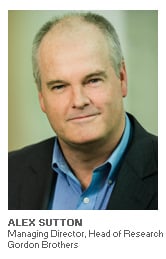
Alex Sutton: The value of nearshoring or just having geographic supplier diversification today is so much more than it was prior to 2025. Most companies, especially importers or exporters, need to make sure they can manage the volatility of tariffs seen today. It's critical.
And it's not just tariffs. We saw supply chain issues a few years ago during the pandemic, and now we have the Iran war, which will likely change trade flows as there are so many more goods and commodities coming out of the Middle East today than ten years ago.
Companies must have geographic diversification. They need to have options, and ideally, if they can afford to, they should nearshore as much production as possible.
Toglia: Nearshoring requires capital investment and time. Are middle-market companies prepared to execute on this shift?
Sutton: Yes, I think all companies want to try to nearshore; but can a single company take their entire import supply chain and nearshore it in two years? Even if they had the capital, they probably couldn't do it. For example, it probably takes five years to build a greenfield manufacturing plant. Companies may be able to find some third-party logistics providers or some kind of processor that could take on more of their work, but I think nearshoring is still the direction they are taking. Companies should be looking at what they are producing and determine what is feasible for them to nearshore or, at a minimum, what part of the process can be nearshored.
The second part of that is diversification. A company may not be able to nearshore, or they are not able to nearshore much, but they still need to have geographic diversification. This is much more important now than it ever was in the past.
Toglia: From a lender’s perspective, how are these risks changing underwriting in asset-based lending?
Sutton: At Gordon Brothers, we live in the asset-based lending world. Theoretically, if you put your asset-based lending lens on, you are less concerned with cash flow because you are working with the strength of the collateral values. So again, theoretically, as an asset-based lender, the thesis of lending isn't necessarily affected by these issues.
But when it gets down to brass tacks, there's a lot more to consider to ensure you are on the right side of in-transit inventory:
- How are tariffs being capitalized in the inventory costs?
- What kind of variances are there?
- What kind of liabilities are present under the higher tariffs compared to the past when Most Favored Nation tariff rates were only 2% or 3%?
- Do you have the liability covered in your borrowing base?
It's no longer a de minimis rounding error; it's a material number. So, it's the weighting that is significantly higher.
Now, if you're cash flow lending, there are many more issues you have to consider, but it comes down to risks and what ifs. You have to look at every situation independently and have your own geopolitical lens on it, which is not an easy thing to do.
Toglia: Which sectors are most exposed to tariff volatility today?
Sutton: On a percentage basis, retail has probably had the biggest exposure because there is such a high reliance on imported goods, so they face a lot of pressure. In 2025, many types of consumer goods—including apparel, footwear, home goods and toys—were hardest hit on the retail side.
Certainly the automotive sector has been impacted, both on the aftermarket side and on the original equipment side. There is so much interconnected tissue with tariffs and the automotive sector resulting from trade paths in North America, where you could have five or six transfers of a part.
Steel and aluminum have also been impacted, and we have not seen the tariff exemptions that we saw in the past.
Anyone in the import/export industry, and certainly agricultural exporters, has not done well. These industries are losing market share because customers are finding other markets, and it may become very difficult to get some of that market share back.
Solar is another impacted industry, though it might benefit from some of the geographic instability as people realize that it’s better to produce energy at home rather than halfway around the world.
Toglia: How is tariff volatility impacting collateral values?
Sutton: Let’s break it down by type of collateral, and look at inventory and machinery separately.
When a company has been affected by tariffs, the two most common things we see with inventory are declining margins and higher levels of slow-moving inventory. Both of those have a negative impact on collateral value.
In general, tariffs increase inventory levels so if you have the same amount of volume, you have more inventory on a dollar basis. It almost lengthens the supply chain, and you would have a higher percentage of your inventory in transit. Many companies bought more inventory before the tariffs went into place. Supply chains are nowhere near as just-in-time as they used to be. I think we’ll see that trend for a longer period. We have seen some companies gain market share with aggressive pricing strategies and by strategically not passing along the price increases quickly.
On the machinery side, inflation caused by tariffs on machine tool prices is generally getting passed on to the buyer, so this sector is seeing an uptick. There is a lot of domestic investment going on (nearshoring), which puts a premium on certain equipment types. This has also benefited the used equipment market.
Toglia: What should lenders be monitoring more closely in this environment?
Sutton: The one thing that has been surprising to me is the number of companies we have been involved with where the tariff cost is not being recognized in the company's systems—in the inventory perpetual at the line-item level.
If I were a lender, I would want to see how closely the company is accounting for tariffs, what level of detailed information they have, and what they are doing from a pricing perspective, to make sure that they are not experiencing margin erosion. And then on the in-transit side of lending, lenders should make sure they have a full understanding of it—what has been paid, what hasn't been paid, and where that liability is reflected. Is it included in the cost of the inventory? Can I reserve against that liability?
Overall, I suggest a tightening up of the diligence that's being done on everything related to tariffs.
Toglia: Do you expect tariff and geopolitical volatility to continue?
Sutton: That's a tough one. I do think that there's a part of the administration that is very intent on getting trade policy right. At the same time, I suspect there is concern about the impact on inflation and the consumer, so there's a bit of tension between the two.
Right now, I'm concerned about ongoing geopolitical instability as there are so many more commodities coming out of the Middle East that are bottled up in the region. I expect there will be more volatility—not all tied directly to trade policy or tariffs, but I do think there's more volatility to come.
Toglia: Any last thoughts for lenders and operators navigating this environment?
Sutton: I think people underestimate how burdensome tariffs [are] to companies. It's been exceedingly difficult to deal with as it’s very hard for companies to pass along a 15, 20, or 25% price increase and/or change suppliers on a dime. A lot of companies are trying to do a lot of different things to navigate through this. There's so much going on in this environment, and it's difficult for companies to manage it.